Interview: Marie Claire UK

Marie Claire UK did an interview with me and a few other asexual people for its December 2014 issue. You can choose your platform and download it for a small fee here (make sure to get December 2014).
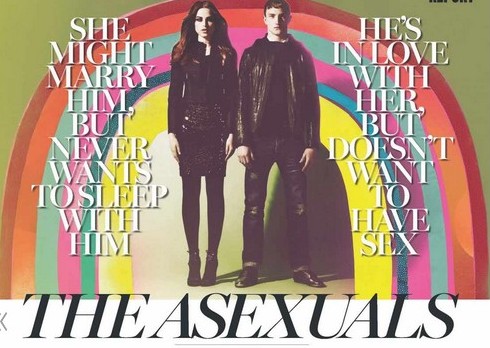
theasexualsBecause it is a for-sale magazine and there is no online companion, I can’t show you the whole thing, but here is my quote:
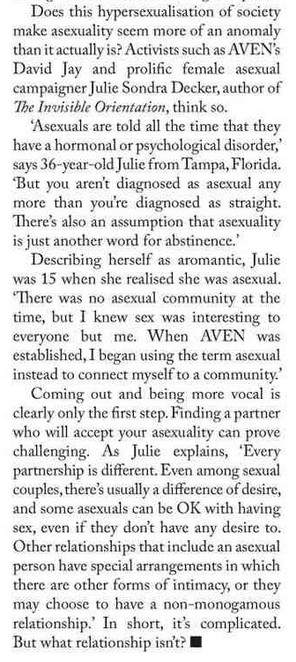
marieclaireukI was interviewed through e-mail, so I was surprised that several of my quotes didn’t get what I said correct.

Their version:

Describing herself as aromantic, Julie was 15 when she realized she was asexual. ‘There was no asexual community at the time, but I knew sex was interesting to everyone but me. When AVEN was established, I began using the term asexual instead to connect myself to a community.’

This quote implies that I used to call myself “aromantic” BUT HAVE NOW “switched” to using “asexual” because of AVEN. That’s incredibly misleading because I use both terms NOW and did not claim to use “aromantic” as a teen. Asexuality and aromanticism are not necessarily related. When I described using the word  “asexual” instead, was describing my switch from the word “nonsexual,” which I always used before there was a community that preferred “asexual.”

Here is my original statement:

I identify as an asexual aromantic woman—”aromantic” meaning I also don’t feel romantic attraction. Romantic orientation is separate from sexual orientation for a great many asexual people, and some do want romantic relationships even if sexual attraction doesn’t develop for them.

This is the only place I mention “aromantic” in my set of answers, so how it got conflated for the term I switched to “instead” is beyond me.

My original response, on using “nonsexual” as a term:

I was about fifteen years old when I started calling myself “nonsexual.” There was no asexual community at the time, but I knew sex was very interesting to everyone but me, and it seemed like enough of a difference to have to call it something. When the Asexual Visibility and Education Network was established by David Jay in the early 2000s, I began using the term “asexual” instead to connect myself to the community and visibility efforts.

So you see how that really was not unclear. I don’t know how it became so in the article.

Also, they tweaked my words at one point. The interviewer asked me about dating and dating sites for asexual people. I discussed mixed-orientation dating a bit after explaining why it’s rare for asexual people to be able to date other asexual people. I wrote this:

There are resources for these mixed-orientation relationships, but every partnership is different. Even in non-asexual couples, there’s usually a difference of desire and opinion on how often and in what ways to have sex, so asexual people aren’t honestly that different, and some may be okay with having sex even if they don’t have the usual accompanying sexual attraction. Some relationships that include an asexual person have special arrangements in which they emphasize other forms of intimacy, or they may have a non-monogamous relationship, like an open marriage or a polyamorous group situation.

That was rewritten to this in the magazine:

As Julie explains, ‘Every partnership is different. Even among sexual couples, there’s usually a difference of desire, and some asexuals can be OK with having sex, even if they don’t desire to. Other relationships that include an asexual person have special arrangements in which there are other forms of intimacy, or they may choose to have a non-monogamous relationship.’

I don’t think this is necessarily a poor choice for simplifying, shortening, and summing up my response (though it lacks some nuance), but for the record, I didn’t call any couples “sexual couples.”

This is not incredibly egregious, considering how wrong many journalists have gotten it over the years, but it does really irk me that “aromantic” is represented as something I used to call myself before I found the word “asexual.” Many aromantic people are very much NOT fans of having our romantic and sexual orientations conflated. I was also assigned words I never said a couple times wherein I referred to asexual people as “asexuals,” and while I don’t object to this language, I prefer not to use it as a noun form, though I do use “aces.”

Still, I appreciated that in a popular, mainstream magazine, the article didn’t drag in some “sexpert” for “balance” to ramble about how we’re probably just refusing to face our sicknesses and trying to make an orientation out of our fear.

Note: There are also some statements in the article that could be taken as sex-shaming or promiscuity-shaming.
 

Pitch Wars Agent Round: The Aftermath

My second year as a Pitch Wars Mentor is complete. And again, I declare it a smashing success.

Some reflections on the whole process:

  • Both my mentee (Megan Paasch) and my alternate (Natalka Burian) were a pleasure to work with. They were polite, patient, grateful, receptive, enthusiastic, and hard-working. I felt so fortunate that I chose folks whose personalities appeared well suited to the temperament one needs in this profession.


  • Both my mentee and my alternate entertained me incredibly with their novels. They were very different–one a New Adult fantasy, one an Adult literary–but I never got bored or tired reading their work, and it never felt like an obligation. They’re both very good writers–well, that’s why I picked them–but they also wrote stories with a soul, and that’s not something that can be taught.


  • Both Megan and Natalka got two agent requests (update: another one came through for Natalka!). It surprised me. Not because I thought they wouldn’t get requests–I thought they would–but they didn’t necessarily come from the agents I thought might nibble on them. I took a chance on both of them–New Adult wasn’t popular in the mentee round, and literary is often such a hard sell in these contests–but I’m pleasantly surprised by the attention we got. I strongly suspect I will have news of one of them signing with an agent very soon.


  • I hope and expect to remain friends and critique partners with both these ladies as we move on in our writerly lives. They’ve both expressed interest in my work too, and I would happily trust them to offer reflections on my own in-progress books. Just because I’m the mentor and they’re the mentees doesn’t mean I can’t learn from them too.


  • Brenda Drake managed this thing like a boss. I’ve never tried to run something on this scale, but I have an inkling of what it takes because of some other stuff I’ve directed, and it’s not easy. She did a fantastic job with all the organization required, but on top of that, she managed to not pull all of her hair out and she handled disputes and gave advice and laid down the law a few times in ways that had to be frustrating, and yet she still comes back up smiling and ready to do it again.


  • The mentors were supposedly the big cheeses in this contest, but we’re insecure too sometimes. If our mentees got no requests, or fewer requests, we questioned ourselves. Did we give bad advice? Did we pick the wrong direction in which to push our trusting writer pals? Was our judgment faulty? Did we FAIL THEM? Well, the truth is, there is some element of chance in every agent match and every book deal. There is ALWAYS “the right place at the right time.” Some of us would certainly not have our own agents or book deals if we hadn’t experienced some synchronicity or excellent luck; don’t get me wrong, because you do have to have a polished book and write a good story, but the publishing industry is full of chance. Not only did some of the good books in this contest just happen to not strike the fancy of the browsing agents, but some of the books did. It’s not “just luck,” but the agents in the contest are a small subsection of the agenting population, and they pass over things for plenty of mysterious reasons. If an agent requested everything, you’d suspect they had no standards, and you wouldn’t want to sign with them anyway. So authors chosen in this contest can take what they’ve learned and go forth into the querying wildernesses, not only with a stronger manuscript and better query, but with the support of their mentor and a whole community behind them.

Some reflections on this year’s Pitch Wars as it compares to last year’s:

  •  Last year’s mentee match was kinda ridiculous for me because I clicked incredibly well with Whitney Fletcher and we’re still writer BFFs. I don’t have quite as much in common with my folks from this year, but we were still able to connect personally as well as professionally, and I feel comfortable with them.


  • The interaction with the other mentors this year was wonderful. We had a Facebook group that facilitated discussion and putting out of fires, and I got to know several other mentors better than last year. I think a discussion group is a great idea for these contests, and I know the mentees and alternates had their own group too (which I haven’t seen), so I think that helped them too.


  • This year we only got to pick one alternate, and last year we had two. I think it was nice to be able to pick more people, but it ended up just slightly overwhelming for some of us, and I think one alternate is the right choice.


  • Last year my mentee was the first (I think) to be offered representation from an agent who picked him in the contest. It happened within two days. I don’t know the details but I think that ridiculous two-days-from-request-to-offer window might have been beaten by someone else this year. Sure wish my agent search had been in that fast lane!


  • I think the alternate showcase had more love this year. Maybe agents weren’t as overwhelmed with two alternates to view for each mentor? My alternates didn’t get any nibbles at all last year. I’m pretty good with pitching (ya think?) so I don’t think their pitches were terrible–it just seemed kind of quiet when it happened.


  • I got more replies to my feedback this year. Nearly everyone I wrote my page or so of feedback for wrote to thank me, and a dozen or so asked for additional advice or clarification (though I by and large did not re-critique edited query letters). I did disclose to some of the folks who were close that I nearly picked them, and some of the folks I connected with stayed friendly with me through e-mails and on Twitter. That was fantastic!


  • Last year we had problems with our Pitch Wars gmail accounts–primarily because we were all trying to log onto a group account and the system called shenanigans and kicked us out a lot. The submission forms, forwarding to multiple individual mentor accounts, were a huge improvement. (Thanks to Dan Koboldt!) The only down side was that we could not peep on each other’s submissions (which is what enabled me to mess with my mentee’s mind last year and grab his sample pages from another mentor without him knowing I was interested), but that’s a small price to pay–especially with how open we were in our discussion group.


  • Last year we had ninja mentors. This year that didn’t happen, though there were some last-minute changes with mentors because of having to drop out for personal or professional reasons. I think that was a good choice too because it might have felt like dragging the choosing part of the contest out too long, and I thought it was best with one set of decisions followed by moving right on to the critique.


  • Last year we couldn’t request full manuscripts and this year we could. That helped a lot of mentors make their final decisions, but I didn’t request any full manuscripts. I did request more material this year than I did last year, and I requested as I went along instead of waiting until the end. I would do it that way again, and maybe request full manuscripts this time.


  • Last year AND this year I left my decision until the last minute. Last year I strongly suspected I was going to be picking Whitney, even though he was my second overall submission out of more than 70, but I wasn’t positive after reading the excerpts. I really fell in love with the manuscript from my first alternate, Ryan. I still went with Whitney because of a stronger connection to the character. I feel I did make the right decision, but I was conflicted after reading more material. I felt the same this year when I had one mentee in mind and then didn’t feel the same after reading the excerpts. Sometimes you just know, but sometimes it’s about the long game.


  • Last year and this year I accepted Adult and New Adult. I think I will continue to do that if I participate next year. I think I will emphasize in my bio that I don’t want romance books. These past two years I did say I would take romance as long as the romance wasn’t all there was, but I still received a fair amount of romance and fell in love with none of it. That’s not really fair to the people who submit to me thinking I’m more open to it than I am. Next year, if I’m involved, no straight-genre romance.


  • Last year I gave a ton of feedback to the people I was passing on–just over 45,000 words for 74 submissions. This year I gave a similar amount of feedback to the people I was passing on, but I had far more submissions, and my total word count on the feedback was about 60,000 words for my 103 subs. I would do it again. I enjoy the process and love helping these writers. Last year it felt more laborious, though I still liked writing out my thoughts in a constructive manner. This year for some reason I enjoyed it more. I’m glad since there was so much more to do.


  • Last year I did not have a book coming out the week of Pitch Wars decisions, and this year I did. That put my stress level through the roof. I had taken the week of my release date off so I wouldn’t have to be a distracted slacker at the office, but to be honest, Pitch Wars ate it. If I have my choice, I will never, ever share a release date with a Pitch Wars event again. It was too much. But I survived. Thanks to coffee, my friends, and the support of my community.

I’m looking forward to cheering people on as they move forward in their writing careers, whether that be to agents, straight to publishing, or on to their next books.

Interview: Sexperts

I was interviewed about asexuality on Dr. Limor Blockman’s podcast Sexperts—which is a Playboy-affiliated podcast just so you know.

This is the direct link to the download of my interview.

My interview starts after a commercial at about 41:00—forty-one minutes in. I stress that anyone who for any reason does not want to listen to very explicit content should please make an effort to skip right to my interview, because the person who is interviewed right before me is discussing some kink situations (including BDSM, sadism specifically), and there’s a lot of sexually explicit detail. (If that’s your thing, listen to that too! 😉 )

If you’d rather listen in the browser and/or not download the content, I think you can get it here:

Sexperts Episode 32: Different Strokes

The interview with me is brief, but the interviewer knows how to ask open questions and didn’t confront me with any ignorance (though there were a couple phrases about “choice” that I think were not the best choice of words).

Interview: Pleasure Mechanics

Today I joined Chris of Pleasure Mechanics in discussing asexuality and my new book on the Speaking of Sex podcast. This was a really lovely interview; for once we got to discuss some pretty nuanced aspects of the orientation, some discussion beyond the basics, and a fair amount of practical application—what asexual people are learning from queer communities, and what everyone can learn from us.

Check out the interview here; it’s about 30 minutes long.

Interview: BBC Radio Berkshire

I was interviewed by Andrew Peach on the subject of asexuality in general. (I’m referred to as an author but my book isn’t really mentioned, sadly.)

The interviewer did ask a lot of leading questions (like “do you feel like you’re missing out on a part of the human experience that’s supposed to be there?”), but he was basically respectful when I gave straightforward answers. It wasn’t a bad interview, though I think the Skype recording caused a couple glitches.

Update:

Sadly the recordings expire after seven days, so there is no way to listen to this now.

New Video: Writing Every Day?

Some people love giving advice to new/young writers. Sometimes, that advice involves telling others how to do things exactly the way they do things, framing those how-to’s as the only options for becoming successful.

One of the ones I hear most often is “You MUST write EVERY DAY.”

This video is about why that’s not true and why it’s important to trust yourself to find your own rhythm and schedule for your writing.