Review (Prismatic Entanglements): The Invisible Orientation

Elizabeth of Prismatic Entanglements has offered a thoughtful, comprehensive, gently critical review for The Invisible Orientation.

An excerpt:

This is the Asexuality 101 book. It’s for laypersons, but I think it should also be required reading for professionals looking to better serve their asexual clients. It’s a starting point for real understanding, and one that outsiders looking in just can’t provide.

Books are prone to becoming quickly outdated as societal understanding deepens, and even less than a year after its release, there are already some passages beginning to show their age. But that’s more about how fast our high-level community discourse moves! On that level, it makes sense to forgive the subtle nuances rooted in older discussions. Here, we find the community’s foundation, preserved by someone who has been part of it much longer than most of us.

On such solid ground, we can now take steps toward further progress.

Please read the full review on Prismatic Entanglements here.

Completed New Short Story: “Aquarius”

Hey, remember when I wrote a queer story for a submissions call? And I expressed doubt about the story being good enough to get into the magazine?

I was right. It wasn’t chosen. Surprise!

But. I figured it’s not very often that a person has a chance to submit to a special issue that’s looking for submissions from a small sliver of the population that you happen to fit into, and I wanted to take my chances one more time before the deadline and submit again.

So I thought . . . what appeals to me in science fiction? What cool questions do I like seeing explored? What concepts blow my mind? What do I love about this genre?

I thought about one of my favorite short stories of all time, Joan D. Vinge’s “View from a Height,” and remembered how compelling the protagonist’s situation was to me. It’s about a woman with an immune deficiency blasting off on a one-way trip into deep space, and how she reacted when she was far enough from home that she could no longer receive signals from other people. I decided to take a similar concept but do it with a different dynamic–with two people in a spaceship going to the stars for a different reason. The dynamic changes a lot with two.

So I wrote a short story that was primarily about the protagonist and her partner trying to get chosen for the space mission and dealing with prejudice that comes with being in a queer relationship. My protagonist, Becks, is my first ever aromantic asexual protagonist. Her partner, Austin, is gender fluid, and is also on the asexual spectrum (being graysexual and demiromantic). And they’re in a queerplatonic partnership. It was interesting to write partly because there were “rules” attached to Austin’s gender and what pronoun I used had to match. I enjoyed being subtle about that in the narration, even though there’s some very explicit stuff about the gender fluidity in the story.

I hope I’m not too much of a failure when it comes to the actual science, though. I’ve read a lot of stuff that happens on spaceships but I don’t know a lot of theoretical science that would make what I wrote realistic, and it’s not super advanced because it’s only set like a little more than 100 years in the future.

Anyway. “Aquarius” is 7500 words and is going to be submitted to the same submissions call. I like this story better than the previous one and if Lightspeed doesn’t want it then I actually think I’ll have a good chance of selling it somewhere else.

Review (Evening Assam): The Invisible Orientation

Evening Assam, Morning Pu-Er gave me a really nice review for my book on Tumblr. An excerpt:

More than anything this book arms the reader with the vocabulary, and confidence, to start in depth discussion and exploration of their (or their loved one’s) asexuality.  I can think of no better place to start.

The writing manages to be simple and clear without ever patronizing, even when addressing all manner of different groups.  Decker maps out an impressive understanding of those identifying on the asexual spectrum that gives context desperately needed for such an underrepresented topic.

Read the whole review on the blog post!


Article: “Asexuality and the Health Professional”

I published my first blog in Psychology Today, where I’m now installed as a blogger. (See my profile there if you like!)

Because of the nature of the magazine, I decided to tackle health professionals’ responsibility to asexual clients and how they should be educated on this subject if they’re going to treat us.

Please read “Asexuality and the Health Professional.”

Interview: Yorokobu

A Spanish magazine called Yorokobu interviewed me for an article called “Los asexuales reivindican su hueco” (“The Asexuals Claim Their Space”).

Jaled Abdelrahim sent me a list of interview questions in English, which I also answered in English, and then the translated version was published on the site.

You can read it here.

My friend Claudia took a crack at a more accurate translation than Google Translate can provide, which you can read below the cut.

Continue reading

Video: Not-So-Frequently Asked Querying Questions

I’ve got a new video on querying literary agents . . . and this time, I’m addressing the not-so-frequently asked questions. If you’ve got the basics down but have some lingering concerns, check this out and ask your own!

In the video, I answer the following questions:

  • How many agents should I query at once?
  • How long is an average response time?
  • How do I respond if an agent wants to see part or all of my book?
  • Oh God, why am I so nervous? Why is this the hardest letter I’ve ever written?
  • What if all I’m getting are rejections?
  • What if I sent a partial or full manuscript a while ago but then I edited it and it’s better now? Should I send them my updated version?
  • How do I handle approaching remaining agents if one offers representation?
  • What if an agent wants me to make changes to my book and try again?
  • If I get a rejection from an agent, should I reply?
  • What if I get an offer from an agent I don’t want to represent me?
  • When can I list them as my agent on my blog and in my Twitter profile and stuff? I’m dying to tell everyone!
  • What if they seem interested but they refer me to an editor I have to pay for or promise representation for a reading fee?
  • What does it mean if the agent wants to call me?
  • Can I talk about my agent search online?
  • What’s your one piece of advice to an author newly querying agents?

Interview: Maclean’s

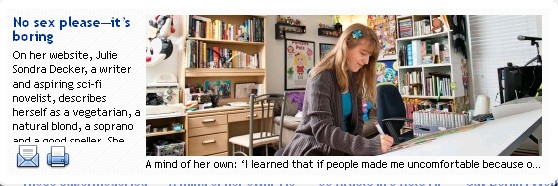
I have a short interview in the December 22, 2014 issue of Maclean’s, a Canadian national weekly news magazine. The article about me is on page 75 of the issue, under “Help,” and its title is “No sex please—it’s boring.” (Not sure who titles these things! I wouldn’t know if sex is boring, though I guess conflating “boring” with “not interesting to me” isn’t that far off.)

macleans

The limited preview on the Maclean’s site

The interview is in the print magazine–which is only sold in Canada–and you can buy the digital edition through the newsstand online here. An online version was later posted here.

The article is pretty super basic with one page of content. It has some nice little tidbits and didn’t sensationalize asexuality or make fun of me or anything. But as is almost always the case with media articles that do not let me check them before they print/post, there are little things I would have preferred to be presented differently, most notably the sentence “Just as some people are born gay, straight or bisexual, Decker says she was born without the desire to have sex.” I do not in fact say that. Because I hate the “born this way” narrative for many reasons, so I’m not keen on being represented as making that claim as if those are the words I’d use or the sentiment I’d express.

There’s also a place where it quotes me as saying some asexual people do decide to have sex and then they finish the sentence for me by claiming it’s “to please a partner,” and I think that is misleading, though of course it’s sometimes true. It also kinda oversimplifies the whole “asexuality is not trauma, it’s not hormones,” etc., but that’s not surprising given the space allotted.

They also made reference to the Apositive site and a post on it, but misspelled its URL as “appositive.org.” It’s supposed to have one P, not two. Maybe spellcheck decided to hit it and no one caught it. The print version has this issue but the online version does not.

My own book is secretly in the photograph, sitting on my desk in the background under some papers. That’s kind of meta.

Review (An Un-Calibrated Centrifuge): The Invisible Orientation

A lovely post about asexuality books by a blogger named Alison has been posted. Alison lists three books on asexuality and discusses their contents briefly, naming mine the favorite. I’m so flattered!

Read the compare and contrast:

Three Books on Asexuality: An Un-Calibrated Centrifuge

Of the three books on Asexuality that I’ve read this year, this one was my favorite. It’s written in very clear, accessible language. It covers a variety of topics and issues. It’s a great starting point for anyone looking to learn more about asexuality.

The book covers Asexuality 101, asexual experiences (this section is very inclusive), myths of asexuality, a section specifically for asexual people (and any questioning people), and friends/family/acquaintances of asexual people. And I haven’t checked them all out yet, but the resources at the end of the book look great.

Five Hundred Issues

My webcomic, Negative One, hit 500 issues on Friday.

That’s a lot of issues.

So. Uh.

Sometimes people ask me why I put so much time into a webcomic if I’m not trying to “go” anywhere with it professionally. I am indeed under no illusions that I am or will ever be a professional-level artist, and that’s not something I’m saying to take shots at my abilities so much as I’m saying I am not willing to put the time and effort into learning that craft to the extent necessary to do it as a career. It’s not something I’d ever want to do for money, even if someone handed me the opportunity without me having to ask for it; I draw as a hobby, and that’s all I ever want it to be. Most of the time, my art is mediocre, and I’m satisfied with that because it’s a vehicle for the text. Occasionally I feel like spending a little more time on a drawing and one of the frames comes out especially nice, but it’s pretty rare.

The answer is that Negative One is what happened when I realized a story I loved wasn’t publishable and never would be. I spent my college years and some time after devoted to writing a series of fantasy novels called The House That Ivy Built, and for the most part these stories were plotless (or nearly so). They were essentially about one unusual teenage girl trying to find her place in the world and come to terms with certain very difficult aspects of her identity (including superpowers), and when I developed a mature understanding of what sells to publishers, I knew without a doubt that the stories I’d written wouldn’t make the cut. Some folks would probably deal with that by, say, transplanting their beloved characters into a better story, but I didn’t want to graft other events onto this character’s life. I just wanted it to stay the way it was, even if that meant I couldn’t sell it as a fantasy series.

What Negative One represents for me is, essentially, indulgence. See, I have read my share of webcomics and saw that most of the popular ones–like most popular writing–are concise, funny, and in touch with mainstream tastes, and I figured I was way too long-winded to ever feel comfortable telling a story in those claustrophobic talk bubbles, but I have also happened upon a few that used unconventional storytelling and utilized the most versatile aspects of the digital medium to make their stories sing. I realized I could actually get away with telling a story in a visual format as long as I found a way to include my characters’ internal monologue, and it worked out great for me.

Negative One is where I get to relax a little. Tell a story without worrying that I’m doing it too slowly, or that my pacing isn’t right, or that the characters are too introspective, or that there isn’t enough action. I’ve come to realize I need a place like that. Where I’m not making the story or the art according to other people’s tastes and whims, but according to mine. It’s like a chance to blow off steam, but unlike in a journal or personal sketch diary, it’s not private. Other people can choose to include themselves to the extent they wish to, and there happen to be some readers out there who appreciate that the comic isn’t much like everything else.

It’s for sharing my characters, continuing to experience them and watch them grow, watching them interact, and making something that bucks tradition. It’s for fun, and for nostalgia, and for keeping my pencil from getting rusty. And since I have a hard time justifying carving out time for other projects or time-consuming activities that are just for my own enjoyment, I like that this occupies an inalienable niche in my life that I always work around and post faithfully every week. It’s kind of like announcing that regardless of what else is going on, I can still prioritize something that is for me.

And if it also happens to be for you, welcome to my weird little world.
Review (Ace, Ace, Baby): The Invisible Orientation

One of the bloggers who received a review copy of my book from my publisher decided to share some thoughts on it, and they’re lovely. A full enthusiastic review is posted here on the Ace, Ace, Baby Tumblr.

An excerpt:

I honestly could not think of a better person to write this book and I’m so glad something like this exists. The book covers historical studies, and the differences between things you might not even realize should be separated. Decker’s skills as a writer also show when it comes to how well versed and organized this book is.

🙂
